
Thursday, September 8, 2016


Tuesday, October 22, 2013
Blast Wind In-Depth: Hardcore Gaming 101

Everyone's favorite obsessive retro site recently published my review/analysis of Technosoft's Blast Wind. You can check it out here.
Some highlights:
- Blast Wind's arcade origins and the mysterious Inazuma Saber.
- Working Design's plans for Technosoft's Saturn library.
- Why Blast Wind never interested Thunder Force fans.
- How to play Blast Wind "properly".
Don't forget to listen to Tsukumo Hyakutaro's soundtrack while you read:


Thursday, October 10, 2013
Rob Lord and Mark Bandola's Saturn-Exclusive Wipeout Tracks

I'm a big fan of the Wipeout franchise. The gameplay is addictive and the music kills - especially Tim "CoLD SToRAGE" Wright's work. One interesting bit of music-related trivia is that licensing issues forced the Sega Saturn version of the first Wipeout game to drop several of the tracks from the Playstation original. These tracks then got replaced with three Saturn-exclusive exclusive pieces composed by Mark Bandola of The Lucy Show and veteran jack-of-all-trades Rob Lord.
The exclusive tracks are on YouTube, but YouTube tracks aren't real music. Am I right? I couldn't find any "real" links online, so I just decided to rip them from my own copy. Here they are, in lossless FLAC and 320kb MP3. The host is MEGA. If the links go down, hit me up. Otherwise, enjoy!
Warning: AGwolf2097 from YouTube has pointed out that Planet 9 has two loud pops in the left channel - one at 1:00 and another at 3:24. He's remastered his versions on YouTube to remove these artifacts, and I've uploaded his fixed MP3 below. That said, the FLAC lossless version will remain faithful to the source audio (blemishes and all) and will not be updated.
FLAC, ZIP (111 MB)
MP3, ZIP (36 MB)
Planet 9 (AGwolf2097 Remaster), MP3, (9MB)
 |
| Planet 9 @ 1m00s |
Planet 9:
Gotta dig the jam on this one. Dives right into a rolling breakbeat, then layers in some crowd cheers for that future hovercraft racing vibe. Sticks in a tight box for the duration of the track - upbeat, energetic, and just plain groovy.
Brickbat:
This track kicks off with a retro Detroit Techno sound, snaps into a hip sampled guitar riff, then gutters its way to the end by remixing and recycling those two natty elements.
Poison:
Chill-out track - mellow jamming on the synthesizer provides an abstract lead-in to a earworm hook. Bumping bassline throughout, gets angry before the sixty second minute mark. Another Detroit Techno sound, very similar to Streets of Sim City, if you've ever played that game.
Wednesday, May 29, 2013
Unpacking Saints of Virtue's .WRS Files
For better or worse, I'm probably one of the handful of people out there who takes any interest in Saints of Virtue. But hey, sometimes things just strike a chord. You can hit that HardcoreGaming101 link for all the information regarding the game. No need to repeat any of it - if by some miracle you're interested in this, then you don't need much background. This blog post is a short tutorial on how to open up the game's .WRS files and get at all of the assets - graphics, music, code, sound effects, you name it.

.WRS files are packaged, encrypted assets from Conitec's 3D Gamestudio engine, which Saints uses a very old version of (A3, to be exact). What's funny is that I used to make games in the A5 version of this engine as a kid, so imagine my surprise when my younger self recognized the bootscreen and filetypes Saints used. From that moment I started trying to hack my way in to get at the music and sounds, but no luck. There was some utility I can't remember - had Bread in the name - that was supposed to support .WRS files but it didn't work for these. I gave up, and for years I forgot about it.
Imagine my surprise when I did a random Google search on a whim and came up with this thread, detailing a working way to extract the game's assets. So here we go, what you'll need:

.WRS files are packaged, encrypted assets from Conitec's 3D Gamestudio engine, which Saints uses a very old version of (A3, to be exact). What's funny is that I used to make games in the A5 version of this engine as a kid, so imagine my surprise when my younger self recognized the bootscreen and filetypes Saints used. From that moment I started trying to hack my way in to get at the music and sounds, but no luck. There was some utility I can't remember - had Bread in the name - that was supposed to support .WRS files but it didn't work for these. I gave up, and for years I forgot about it.
Imagine my surprise when I did a random Google search on a whim and came up with this thread, detailing a working way to extract the game's assets. So here we go, what you'll need:
- A copy of the Saints of Virtue CD-ROM, or the downloadable version.
- QuickBMS. Latest version here, backup of 0.5.21 here, just in case.
- Extract script.
It's pretty simple. The specific steps:
- Run quickbms.exe.
- Select the saints_of_virtue_script.txt file you downloaded.
- Select your desired .WRS file.
- Select a folder to output to.
And we're done! QuickBMS will dump all the .PCX, .WAV, and .WDL files to your specified folder for your perusal.
As an extra Saints note, what few people talk about this game online often complain about how you jump so high you hit the ceiling. Or, if they play far enough, they might notice that the Sword Blaster fires cripplingly slow, even with the Rapid-Fire upgrade. Both of these issues are due to the uncapped framerate screwing up the game logic. Use the FRAPS 30FPS locking technique I described in my previous Streets post to fix these problems and enjoy Saints as it was intended to be played.


Running Streets of SimCity on Windows 7 x64
Okay, well, any fan of the game knows that 'running' is a relative term. The game was always prone to crashing, even back in the day on 32-bit Windows 95 and XP operating systems. But if you're reading this then you probably know that some hot Streets action is worth a few "unrecoverable errors", as the familiar in-game popup goes. I'm going to stamp a big sloppy "YMMV" on this technique, so don't bother asking for troubleshooting help or whatever when these steps don't work for you. My guess is that it will probably get the game running on most computers but your graphics card is going to be the deciding factor. For the record, my machine's vitals:


- Windows 7 Home Premium x64
- Mobile Intel 4 Series Express Chipset
- Pentium Dual-Core T4400 CPU @ 2.20 GHz
- 4 GB RAM
Obviously that's more than enough to run Streets. In fact, it's a damn sight too much. But more on that later. Next up, what you'll need to follow this tutorial:
- Hacked x64-compatible ENSETUP.EXE file.
- Pre-patched STREETS.EXE file.
- Copy of the original release on CD-ROM.
- FRAPS
The bare-bones simple version of the tutorial:
- Copy the Streets disc to your hard drive.
- Replace \setup\ensetup.exe with the hacked version above.
- Install the game using the new ensetup.exe.
- Reboot. (Important!)
- Replace the streets.exe file with the pre-patched version.
- Setup FRAPS to record a 30FPS video and lock the framerate while recording.
- Run the game with 256 color and "Run as administrator" compatibility options.
- Once in the game, hold down your Video Capture Hotkey button for several seconds until the FRAPS framerate indicator turns pink and indicates that it is in replay recording mode.
- Enjoy the nostalgia.
And now, the long version.
There's basically two problems that people run into when trying to play Streets on modern Windows XP and 7 systems. The first is the inability to execute a 16-bit installer on an 64-bit system. The second is that even on a 32-bit copy of Windows XP where you can get Streets to install, there's a problem where the uncapped framerate gets ridiculously high and causes problems - most visibly manifested in an AI glitch where the enemies constantly use the Hopper mod instead of actually driving around. This tutorial will fix both problems.
I created the hacked x64-compatbile ENSETUP.EXE file using the method outlined in this thread, which also summarizes the underlying problem quite nicely:
Indeed. If you try to run the SETUP.EXE file on the Streets CD-ROM, you'll get an error saying that "ENSETUP.EXE is missing or damaged." That's not entirely accurate, though. It's not missing or damaged, it's just a 16-bit installer! Try to execute that file from D:\setup and you'll get the following error message:From about 1995 to 1998 it was common practice for setup programs to launch using a Windows 3.1 16-bit loader stub. This gave installers the ability to package multiple binaries for Win16, Win32s, Win32, and Windows NT for Alpha CPUs. At the time it was a reasonable thing to do since all of these platforms could execute 16-Bit Windows 3.1 applications. Today...64-bit Microsoft Windows [don't] implement the ability to run 16-bit Windows 3.1 applications. The result is that there are many, many 32-bit programs that would run fine on these OSes, but are prevented from installing.

So what I did was run that setup file on an x86 Windows 7 machine and then pull the result ._MP file from the system Temp directory and rename it as an .EXE. Presto, we have an installer compatible with x64 machines.
As mentioned in the short tutorial above, you'll need to copy the entire Streets CD to hard disk and replace the old ENSETUP.EXE file with the new, x64 compatible one. You'll notice the new one is much larger than the old one, which makes sense because it has been unpacked. I'd recommend running it as administrator when you install the game. After that, be sure to reboot. I tried to skip the rebooting step the first time and continued through the whole process. The game worked fine...until I rebooted. It stopped launching and it never worked again. Had to uninstall and back all the way up to square one. Don't suffer through that - reboot!
Once you've back in action, you'll probably want to copy the \sound\radio folder from your local copy of the Streets disc onto the installed version in C:\Program Files. You can also copy the movie files and a lot of other assets as well, but it's not strictly necessary. For some reason Streets makes my disc drive sound like a buzzsaw when it access content on the D:\ drive, so the more that's on my hard disk the better. Up to you, though.
The next step is to apply the Voodoo Rush Fix patch. Normally you would just download it here (or, backed up here for posterity), copy it to the same folder that contains Streets.exe in your C:\Program Files installation directory, and execute it. But since it, too, is a 16-bit executable and doesn't even work with the same Temp folder extract trick as the main installer, you're out of luck. Except you're not, because I've already patched Streets.exe on an x86 system and provided it for upload above. So drop that sucker in place of the original.
A note here. This is all assuming you're using the "1.0" initial release of the game. I think that the later SIM Mania compilations have the Streets.exe file already patched, but I'm not sure. My copy is deep in the closet and I don't feel like digging. For the record, though, my original release version of Streets had a Streets.exe file with a size of 3,321 KB pre-patch. The patched .EXE is 3,338 KB.
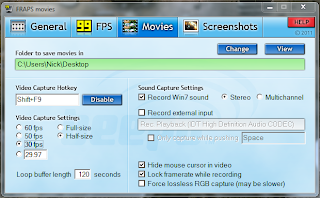
Now you have Streets installed and patched. This fixes the first of the two problems mentioned above, but if you set your shortcut to 256 color mode and run as administrator, you'll get the too-familiar crazy hoppy AI glitch. That's where FRAPS comes in. You see, Streets runs at a very high framerate on modern systems - in the hundreds of frames per second, if not thousands. For some reason this wreaks havoc on the AI and also makes the physics and car handling way worse than Streets ever was - and we all know it wasn't too hot to begin with. What we're going to do is use FRAPS as a cheapo CPU stepdown tool to throttle the game down to a sane 30FPS. You could probably use a real CPU stepdown tool, but this method works and I can't be bothered to figure out another method. So, install FRAPS, and set up your options to look like this:

The pertinent options are to set the capture speed to 30FPS and lock framerate while recording. The other settings like fullsize/halfsize and loop buffer length are kind of up to you, but I found those settings stressed out my machine the least. But I haven't tested much. Anyway, you're going to boot up the game and then hold down your video capture hotkey - in my case SHIFT+F9 - for a few seconds until FRAPS starts recording a short replay buffer. The framerate indicator should turn pink in fullscreen mode or a sort of light blue in windowed mode. This is great because it will force Streets to run at 30FPS but it won't consume your hard drive space with a worthless multi-gigabyte video as you play. The replay buffer feature was added in a recent (at the time of this writing) version of FRAPS, so you may need to update/upgrade if you're running an old version.
Some caveats. The game doesn't run perfectly. Sometimes FRAPS hogs too many resources and the game gets kind of choppy for a few seconds. You still get the occasional "unrecoverable error" just like the good old days. I also haven't done much testing between forcing windowed mode with -w on the shortcut arguments or running in fullscreen. Of course in windowed mode you can see everything in the correct aspect ratio, but my gut instinct is that you get more crashes that way.
But the game works! And for a few nights of mindless mayhem and rocking, thumping, jangling Jerry Martin tunes, isn't it worth it?
You'll see stuff over the internet (thanks to Wikipedia's article on the game) about using a Glide wrapper. To be honest, I had no luck with that route using nGlide - even though the program claims to support Streets once you apply the Voodoo Rush Fix patch. In fact, I had the game working and I tried nGlide to see if it would fix the framerate problem and eliminate the need for FRAPS. nGlide broke the game - it would crash every time it changed from the car garage engine to the in-game 3D engine - and I had to start over. So, yeah, screw Glide wrappers.
Hopefully this guide was helpful to you. Streets 'fans' know that this was a fun game buried beneath a lot of problems. It wasn't perfect, but most people have a skewed image of it due to the Hopper AI bug and the other problems caused by the uncapped framerate. If I'm missing any important steps let me know, but I'm not going to bother helping you with tech support so don't bother. If there's sure-fire ways to improve these steps, though, let me know about that, too.
In the coming weeks I'll hopefully have an article up on HardcoreGaming101, and when that happens that article will probably link here for a more detailed explanation. It will be good to help open the internet's collective eyes and give the game a fair shake.

Thursday, February 14, 2013
#0013 – Fast Striker – 2010 – Dreamcast – NG:DEV.TEAM – Shmup
NG:DEV.TEAM's second shmup for the Dreamcast takes a completely different approach than Last Hope, and should be a more comfortable outing for most shmuppers as a result. The boys from Germany have tossed out the slower, memorization-based gameplay and brought in the bullet-hell style popular in more recent shmups from Japan. Think Cave.

Personally, I prefer this style to R-Type. It doesn't require memorizing the entire stage, and instead encourages quick reflexes and familiarity with the nastier boss patterns. (But hey, there's no accounting for tastes.) Fast Striker also offers quite a bit more variety in the form of game modes that change the feel of the game. At the main menu you can select from "Novice", "Original", "Maniac", and "Omake". While those might sound like difficulty levels, they're actually a lot more than that. Each mode adds new gameplay mechanics as well as overall difficulty, allowing shmup fans of all skill levels to find a gameplay experience that's right for them. Novice is your basic nuts and bolts for beginners - you can shoot default guns and collect stars for points. Original forces you to chain score items (gold nuggets) to maintain your multiplier, adds a one-time-use shield system, and the ability to hold the fire button down for more focused fire. Maniac retains all the features of Original and adds a 'grind' mechanic where focused fire at close proximity prevents gives big points. Omake is a more difficult version of Maniac.
Maniac is my favorite by far. Omake is just too tough for this average shmupper, and the other modes seem dull and empty without the grind mechanic. Seriously - chaining your score and getting in close to heavy enemies to activate your grinder beam is challenging and makes beating your high score a real treat. It encourages risk/reward tradeoff and forces you to think about how you kill enemies in order to keep your chain going. Usually in shmups I focus on how far I can get with one credit instead of trying to score big, but for some reason Fast Striker is one of the few that can coerce me to try for the big chains. (Mars Matrix is another.) There isn't much to unlock or strive for beyond score, but serious players can upload their scores to NG:DEV.TEAM's online leaderboards.


Personally, I prefer this style to R-Type. It doesn't require memorizing the entire stage, and instead encourages quick reflexes and familiarity with the nastier boss patterns. (But hey, there's no accounting for tastes.) Fast Striker also offers quite a bit more variety in the form of game modes that change the feel of the game. At the main menu you can select from "Novice", "Original", "Maniac", and "Omake". While those might sound like difficulty levels, they're actually a lot more than that. Each mode adds new gameplay mechanics as well as overall difficulty, allowing shmup fans of all skill levels to find a gameplay experience that's right for them. Novice is your basic nuts and bolts for beginners - you can shoot default guns and collect stars for points. Original forces you to chain score items (gold nuggets) to maintain your multiplier, adds a one-time-use shield system, and the ability to hold the fire button down for more focused fire. Maniac retains all the features of Original and adds a 'grind' mechanic where focused fire at close proximity prevents gives big points. Omake is a more difficult version of Maniac.
Maniac is my favorite by far. Omake is just too tough for this average shmupper, and the other modes seem dull and empty without the grind mechanic. Seriously - chaining your score and getting in close to heavy enemies to activate your grinder beam is challenging and makes beating your high score a real treat. It encourages risk/reward tradeoff and forces you to think about how you kill enemies in order to keep your chain going. Usually in shmups I focus on how far I can get with one credit instead of trying to score big, but for some reason Fast Striker is one of the few that can coerce me to try for the big chains. (Mars Matrix is another.) There isn't much to unlock or strive for beyond score, but serious players can upload their scores to NG:DEV.TEAM's online leaderboards.

Fast Striker has endured a lot of complaints for the repetitive backgrounds. If you look up a gameplay video you can see that they're all CG-rendered sprites that tile after a single screen. The animation is quite smooth and provides a sense of depth, but I can definitely understand the complaint. If you really appreciate little details and lost of hand-drawn luxury in stage backgrounds, Fast Striker is going to look like a budget title to you. The ship designs are also a little generic - bulbous, and with a high-contrast, plastic vibe. But the bullets are easily visible against the backgrounds this time, and the art has a cohesion from start to finish. Sound isn't anything to comment on in a good or bad way. It's perfunctory. The music, however, is catchy European rave and isn't a bad listen at all.
The Neo-Geo version is notable because of how much it pushes the hardware. NG:DEV.TEAM came up with some special techniques to get so many bullets to display at once. Layered backgrounds and sprite illusions, from what I hear. For the Dreamcast - home of several shmups with much higher bullet counts - it's not nearly as impressive. Then again, that's a problem with most of these releases. The Neo-Geo is impressive hardware to this day, but the Dreamcast has it beat when it comes to processing capability (not storage access speed, as can be seen in some of the SNK ports for the DC). I'm still looking forward to Duranik's Sturmwind as an example of what can homebrew can really get out of the Dreamcast.
As of Valentine's Day, 2013, Fast Striker is out of stock at NG:DEV.TEAM's online shop and eBay listings are completing at around $45 dollars. If you think Fast Striker is for you, I'd recommend waiting a while to see if NG:DEV.TEAM puts out another "Newcomer Bundle" package deal like they did for the Dreamcast release of GunLord. It would be a much better value than dropping $45 for Fast Striker alone. As with Last Hope, it's difficult to recommend Fast Striker to anyone who's still missing out on the Takumi Dreamcast shmups or other important genre staples. But if you've played everything else and you're hungry for a solid indie Dreamcast shmup, Fast Striker will show you a good time.

Wednesday, August 1, 2012
#0012 – Last Hope: Pink Bullets – 2009 – Dreamcast – NG:DEV.TEAM – Shmup
How does "in a few days" turn into an entire month? When it's summer, that's how! Too many games, too much work, too many projects! Anyway, I've been able to put some playtime into all of NG:DEV.TEAM's games for the Sega Dreamcast, and this is the first of three mini-reviews. No promises this time on when the others are coming.


Last Hope: Pink Bullets is technically an updated version of the original Last Hope, but it's kind of wrong to think of it that way. It's not like this version is a bugfix release for major flaws or game-breaking glitches. Really, it's more of a case where the original game was not very well received and the designers took a step back and tried to make their game more fun. Specifically, the original Last Hope was perceived as being unreasonably difficult. And when I say 'unreasonable' I mean cheap. The list of new features in Pink Bullets include such things as higher ship speed, instant respawn, a more powerful protection unit, pink enemy bullets, and "overall less hard difficulty [sic]". Most of those are alterations to general design choices rather than updates and fixes.
On the other hand, don't worry if you're wondering if Pink Bullets will be too easy for you. It's not. The game is still tough - R-Type tough - where success is based on level memorization and preemptive maneuvering rather than sheer reflexes. I play a lot of shmups, but they're usually of the later, mid-90s style. Not quite bullet hell, but a lot twitchier than these sorts of games. In other words, Pink Bullets hands me my butt on a silver platter. A lot like DUX, but that's a different review. I'll admit that this is wholly due to the lack of serious time I've put into the game so far, but I have to say it like it is. Buyer be warned: Last Hope isn't really a pick up and play game. If you want to get far on it without credit spamming, be prepared to replay the stages until you have the hazards and enemy patterns memorized.

The good thing is that Last Hope is a very enjoyable game to put time into if you're so inclined. The prerendered sprite graphics are reminiscent of other Neo-Geo shmups like Pulstar and Blazing Star, with bright lighting glare patches and fluid animations. The backgrounds sport a more hand-drawn, pixel art look, but the overall vibe is more coherent than you'd expect. The music is especially good. The game's OST is mellow and catchy. If you were into '80s and '90s European PC games you know what to expect, but the execution is very slick and well produced. If you've got a lot of money to spend, you wouldn't go wrong picking up the soundtrack album.
I'll leave it to you to check out videos of the gameplay for a better feel of how exactly Last Hope plays. Or, as I said, you can just think of it as R-Type for your Dreamcast with some tweaked features and brighter colors. I will say that using the protection unit didn't come easily to me, but I grew to love it after I realized that it makes you nigh-invincible to oncoming bullets as well as inflict huge damage to enemies. The beam chain scoring multiplier definitely makes the game much more complex if you're going for score, but so far I can barely clear the stages - much less worry about racking up a big multiplier!
Pink Bullets is the definitive release of NG.DEV:TEAM's very first game, and it plays well on the Dreamcast with either a pad or a stick. It works with VGA (and looks fantastic) and isn't that expensive anymore because of the recent reprint. Unless you're specifically into R-Type style games or Euroshmups it's a little hard to recommend buying this one over the stable of Dreamcast (or, more generally, Saturn) shmups already available, but it's a solid approach to a subgenre of shmups that isn't very well explored on the system post-2001. And if you already have most of the must-buy shmups for the platform, well...what are you waiting for?

Friday, June 29, 2012
NG:DEV.TEAM's Newcomer Bundle

NG:DEV.TEAM has been the premiere indie games company for both the Neo-Geo and the Dreamcast since their first release in 2006. That's not quite as dramatic as it sounds, since they have no competition on the Neo-Geo and very little (recently) on the Dreamcast. NG:DEV.TEAM's trilogy of action games are certainly flawed and highly controversial in certain communities, but there's no denying that they have a level of polish that outstrips other Dreamcast indie titles such as Cool Herders, Rush Rush Rally Racing, and even DUX. This year will hopefully see the release of Duranik's stunning Sturmwind for Sega's "Console That Could", and maybe then NG:DEV.TEAM will get some competition.
Until then, we have the recent Dreamcast release of GunLord to celebrate, and how better to celebrate than with a series of reviews? The Newcomer Bundle is a great way to pick up all of NG:DEV.TEAM's games for Dreamcast, and the pricing isn't bad, either. With the package you get the best versions of all of the company's games: Last Hope: Pink Bullets, Fast Striker 1.5, and the aforementioned GunLord. My copy arrived yesterday, and though I'd played burned CD-Rs of Last Hope and Fast Striker before, it was great to support the company and bag some legit copies to satisfy my inner collector. I'll also be getting Redux: Dark Matters and Sturmwind later this year or early 2013 when they release, so look out for more Dreamcast indie reviews on this blog in the future.
My Newcomer Bundle arrived quite quickly from Germany via DHL Airmail, and in general I was pleased with the construction of the actual products. GunLord suffered from a notably cheaper DVD case than the other two games, but these are all universal-sized inserts. The first thing I did was switch out the box for a higher-quality commercial-grade case from an old DVD movie. Fast Striker and Last Hope were fine as-is. The CD art and manuals are glossy, offset printed, and full of great art. The GunLord manual especially has some amazing boss art and a two-page spread with cherry blossoms and dragons (you can see a bit of it below). I think I still prefer the Limited Edition art for the cover, but I didn't want to shell out for it. C'est la vie.
I also recently got a Hori Sega Saturn stick modded with a Sanwa lever and buttons as well as an additional Playstation 1/2 plug, so playing these arcade-style games was a real treat. Just use the Total Control 3 for Saturn -> Dreamcast controller compatibility or Total Control Plus for PS1/2 -> Dreamcast. At any rate, I'll be posting a few reviews for these games in the coming days, so just keep an eye on this space.

Monday, June 18, 2012
Saturn Metal Slug: Another Look
Nazca's first Metal Slug game stands tall as an inherently pure experience. The numerous sequels added on more and more 'stuff' - new Slug designs, new weapons, new enemies, and even new afflictions like Zombie and Fat modes. The original game continues to impress even now with its sheer focus. The levels are short and sweet, with a difficulty balanced so that even mere mortals can attempt 1cc runs. It might not have as many bells and whistles, but it's clean arcade fun that never feels cheap or bloated. I might be in a minority when I say this, but I'll take the first Metal Slug game over Metal Slug X or Metal Slug 3 every time. Since I'm also a huge retro Sega fan and a ardent Saturn enthusiast, it should be no surprise that I've put more than my fair share of time into Metal Slug for Sega's 32-bit console.

On the left is the official Sega 4MB RAM cart (HSS-0157), created at the request of Capcom late in the Saturn's lifespan. It provides 4MB of additional memory space for the console to use with intensive arcade ports. On the right is one of the many variants of perhaps the most popular Sega Saturn expansion cart - the unofficial Action Replay Plus from EMS. This cart offers import support, cheats, backup save storage, as well as both 1MB and 4MB RAM modes. Basically everything except burned/pirate game support, all in a single cartridge. You'll notice that neither of these cartridges is the one that was intended for use with Metal Slug Saturn and displayed in this post's first picture, the HSS-0150 1MB RAM cart:


You don't hear much about the Saturn port of Slug 1, but when you do you'll usually get a few people saying how it suffers from tremendous slowdown - "almost as bad as Metal Slug 2", they'll say. I never quite agreed with them, but I could understand where they're coming from. Anyone who's been introduced to Metal Slug through emulation or compilations on the PS2 or Wii probably doesn't realize how much slowdown there was on the original Neo-Geo hardware. So when you see Metal Slug Saturn grinding into Matrix-style bullet time halfway through the first level - and you're comparing it to the silky emulation experience - then it can be a big downer.
Pictured above is the way that Metal Slug Saturn was meant to be played. Thing is, very few people ever actually have! Most people who are playing Metal Slug on their Sega Saturn are using one of the two expansion cartridges pictured below:
 |  |
On the left is the official Sega 4MB RAM cart (HSS-0157), created at the request of Capcom late in the Saturn's lifespan. It provides 4MB of additional memory space for the console to use with intensive arcade ports. On the right is one of the many variants of perhaps the most popular Sega Saturn expansion cart - the unofficial Action Replay Plus from EMS. This cart offers import support, cheats, backup save storage, as well as both 1MB and 4MB RAM modes. Basically everything except burned/pirate game support, all in a single cartridge. You'll notice that neither of these cartridges is the one that was intended for use with Metal Slug Saturn and displayed in this post's first picture, the HSS-0150 1MB RAM cart:

This cart is almost identical to the 4MB RAM cart pictured above, except that it was created at the request of SNK instead of Capcom, it predates the 4MB RAM cart by a few years, and it offers a fraction of the memory expansion. Makes it sound like the 4MB cart is better, right? Well, no. You see, while most games that work with the 1MB RAM cart also work with the 4MB RAM cart, several games run into problems when they try to address the extra memory. Some of the games have really obvious issues. Samurai Spirits III and IV, as well as the Real Bout Fatal Fury games, have corrupted graphics. You can't miss it.
The Action Replay Plus switches between 1MB and 4MB modes as needed by the game, and it seems to be the perfect solution. 1MB for your SNK games that need it, and 4MB for everything else. The problem is that when it comes to Metal Slug Saturn, neither the Action Replay Plus nor the 4MB RAM cart work correctly. Worse yet, the issue that Metal Slug has isn't nearly as obvious as corrupted graphics. It's slowdown. And now we come to the reason why Metal Slug Saturn has a worse rep online than it really deserves.
If you're playing Metal Slug Saturn with any cartridge other than the HSS-0150 1MB RAM cart, you're not doing it right. Both the Action Replay Plus (I own the last revision released, with the dual 1MB/4MB modes and the fixes for Vampire Savior) and the HSS-0157 4MB RAM cart introduce additional slowdown despite seeming to work with the game just fine. This is really obvious with some simple tests. Load up the game with a 4MB cart or an Action Replay and check out the slowdown in two crucial areas: the Mission One boss and the section with the boats in Mission Two. You'll notice how much slower it runs than when you use the official 1MB RAM cart meant for the game. Here are the areas I'm talking about (click for bigger versions):
Hopefully this clears up some of the misconceptions about the Saturn port of Metal Slug. It's really a great version, far better than the Playstation version (also on PSN) due to the 1MB RAM cart support and the Saturn's built in memory advantage. In terms of slowdown, it's actually very close to the original arcade performance - once you stop using the wrong expansion cartridges. With the AES version of this game selling for $3,000 or more when it appears, the Sega Saturn version of Metal Slug is about as good as it gets if you want a physical, standalone release. This is especially handy since many retro gamers probably already own a Sega Saturn but might not own a Neo-Geo MVS or CD system.
It's probably important to note that Metal Slug only came out for the Sega Saturn in Japan, which means that running Metal Slug on a Sega Saturn using the intended 1MB RAM cart (as explained in this post) is going to require one of a few different routes:
1) A region modchip installed in a US or EU Saturn.
2) An actual JP region Saturn.
3) A properly region-patched ISO of the game used in conjunction with a backup modchip.
I'd recommend Racketboy.com (especially the forums) as a great starting point for any Saturn modding adventures. A friend and I were able to install a switchless region mod in my US region Model 2 Saturn without too much sweat and blood, and it's definitely an awesome thing to have considering the strength of the JP Saturn library.

 |  |
Hopefully this clears up some of the misconceptions about the Saturn port of Metal Slug. It's really a great version, far better than the Playstation version (also on PSN) due to the 1MB RAM cart support and the Saturn's built in memory advantage. In terms of slowdown, it's actually very close to the original arcade performance - once you stop using the wrong expansion cartridges. With the AES version of this game selling for $3,000 or more when it appears, the Sega Saturn version of Metal Slug is about as good as it gets if you want a physical, standalone release. This is especially handy since many retro gamers probably already own a Sega Saturn but might not own a Neo-Geo MVS or CD system.
It's probably important to note that Metal Slug only came out for the Sega Saturn in Japan, which means that running Metal Slug on a Sega Saturn using the intended 1MB RAM cart (as explained in this post) is going to require one of a few different routes:
1) A region modchip installed in a US or EU Saturn.
2) An actual JP region Saturn.
3) A properly region-patched ISO of the game used in conjunction with a backup modchip.
I'd recommend Racketboy.com (especially the forums) as a great starting point for any Saturn modding adventures. A friend and I were able to install a switchless region mod in my US region Model 2 Saturn without too much sweat and blood, and it's definitely an awesome thing to have considering the strength of the JP Saturn library.

Wednesday, May 23, 2012
Burning the Library of Alexandria
I'm not sure if it's really dawned on people yet that the retro gaming world suffered a horrific blow this January. I'm talking about the fall of Megaupload and the subsequent abandonment of Snesorama.us - a crippling one-two punch to the archival of classic video games as an art form.
If you're unfamiliar with the whole situation, Megaupload was one of the most popular file lockers on the internet from 2005 until January of this year. In addition to countless legal files and personal content, Megaupload was the host of choice for pirates and file-sharers the world over. You almost couldn't run a Google search for an album, movie, or game without turning up dozens of blogs and forums dedicated to uploading digital content to Megaupload. Kim Dotcom's brainchild offered it all - huge file limits, nearly unlimited download speeds, unobtrusive ads, and short wait times. There were even freeware utilities (JDownloader) designed to make Megaupload and its imitators completely automated affairs.

One of the communities that eventually grew around Megaupload was Snesorama.us. The site started out as a small-time ROM outlet, offering the same throttled direct downloads of illegal ROMs that countless other sites in the early 2000s served up. Thanks to the encouragement of the site administration, however, the site's forum members began uploaded games to file lockers and cataloging them by platform, genre, and file type. It was a limited effort at first, but - thanks to some mysterious kind of obsessive internet zeitgeist - it turned into one of the greatest retro community archival efforts in recent memory.
At the height of its popularity in late 2011, Snesorama's tireless volunteers had uploaded essentially complete sets for every system under the sun to online file lockers - mostly Megaupload and a few others. PSX, PS2, Xbox, Gamecube - you name it. Most importantly for retro gaming, the site offered a stunning variety of Sega CD, Saturn, Dreamcast, PC-Engine CD, and NeoGeo games. The site was a digital Library of Alexandria for retro gaming, allowing curious gamers to experience the most impossibly obscure games for obscure systems. Want to play Stellar Assault or Hyper Duel for the Sega Saturn, but don't want to spend $200+ to import it used from a Japanese game shop? Snesorama. Want to experience insanely rare, impossible-to-find games like many of the PC-Engine CD releases? Snesorama.

Even more amazing than its archival effort, Snesorama was home to a variety of homebrew and original hobbyist efforts for older systems. TuxtheWise's Dreamcast Resurrection project offered streamlined Dreamcast ISOs with re-ordered, optimized file layouts that actually provided better performance than the original retail GD-ROMs. The original Xbox's vast array of hard-to-find, grey-area homebrew projects such as the fantastic Streets of Rage Remake v5.0, Quake 1, 2, and III: Arena ports, Beats of Rage mods, and obscure emulator builds were all easily available as well.
The point of all this is that - regardless of your beliefs on file-sharing and copyright law - Snesorama and Megaupload together had achieved something that isn't even attempted by the video game industry at large: a meaningful archive of video game history. Bits and boards are rotting as the months turn to years, and only certain privileged retro games are seeing re-releases in newer mediums. But even then, petty legal conflicts are changing the very nature of the games we know and love. Yes, Crazy Taxi is on XBLA, but what's Crazy Taxi without the Offspring soundtrack? The only way to truly preserve these games is to preserve the original releases in timeless digital formats, accessible to future generations.

Snesorama was working to achieve that. But a combination of media panic and corporate greed led to the shutdown of Megaupload and the destruction of a retro gaming heaven. While some of those rare games and homebrew projects maintain an Internet presence through other sites, many others existed on Snesorama/Megaupload and nowhere else, and are lost...for now. There certainly is no alternative that provides the same level of documentation and organization that Snesorama featured in its prime.
Please understand that I'm not condoning piracy of modern consoles and other media. I see sharing ISOs and ROMs of old, abandoned games as largely a victimless crime. When you download an ISO of Thunder Force V for the Saturn - a game that is out of print in all formats - who are you hurting? Even the aforementioned Japanese resellers coexisted with sites like Snesorama - there will always be a collector community that demands physical copies to satisfy their desires. The digital duplicates live on for everyone else.
This is an issue that needs to be addressed sooner rather than later. When I consider the number of legal obstacles (and apparent lack of interest) that are hindering large-scale archival and preservation of video games through official channels, the cynic in me is already looking for the next Snesorama.

If you're unfamiliar with the whole situation, Megaupload was one of the most popular file lockers on the internet from 2005 until January of this year. In addition to countless legal files and personal content, Megaupload was the host of choice for pirates and file-sharers the world over. You almost couldn't run a Google search for an album, movie, or game without turning up dozens of blogs and forums dedicated to uploading digital content to Megaupload. Kim Dotcom's brainchild offered it all - huge file limits, nearly unlimited download speeds, unobtrusive ads, and short wait times. There were even freeware utilities (JDownloader) designed to make Megaupload and its imitators completely automated affairs.

One of the communities that eventually grew around Megaupload was Snesorama.us. The site started out as a small-time ROM outlet, offering the same throttled direct downloads of illegal ROMs that countless other sites in the early 2000s served up. Thanks to the encouragement of the site administration, however, the site's forum members began uploaded games to file lockers and cataloging them by platform, genre, and file type. It was a limited effort at first, but - thanks to some mysterious kind of obsessive internet zeitgeist - it turned into one of the greatest retro community archival efforts in recent memory.
At the height of its popularity in late 2011, Snesorama's tireless volunteers had uploaded essentially complete sets for every system under the sun to online file lockers - mostly Megaupload and a few others. PSX, PS2, Xbox, Gamecube - you name it. Most importantly for retro gaming, the site offered a stunning variety of Sega CD, Saturn, Dreamcast, PC-Engine CD, and NeoGeo games. The site was a digital Library of Alexandria for retro gaming, allowing curious gamers to experience the most impossibly obscure games for obscure systems. Want to play Stellar Assault or Hyper Duel for the Sega Saturn, but don't want to spend $200+ to import it used from a Japanese game shop? Snesorama. Want to experience insanely rare, impossible-to-find games like many of the PC-Engine CD releases? Snesorama.

Even more amazing than its archival effort, Snesorama was home to a variety of homebrew and original hobbyist efforts for older systems. TuxtheWise's Dreamcast Resurrection project offered streamlined Dreamcast ISOs with re-ordered, optimized file layouts that actually provided better performance than the original retail GD-ROMs. The original Xbox's vast array of hard-to-find, grey-area homebrew projects such as the fantastic Streets of Rage Remake v5.0, Quake 1, 2, and III: Arena ports, Beats of Rage mods, and obscure emulator builds were all easily available as well.
The point of all this is that - regardless of your beliefs on file-sharing and copyright law - Snesorama and Megaupload together had achieved something that isn't even attempted by the video game industry at large: a meaningful archive of video game history. Bits and boards are rotting as the months turn to years, and only certain privileged retro games are seeing re-releases in newer mediums. But even then, petty legal conflicts are changing the very nature of the games we know and love. Yes, Crazy Taxi is on XBLA, but what's Crazy Taxi without the Offspring soundtrack? The only way to truly preserve these games is to preserve the original releases in timeless digital formats, accessible to future generations.

Snesorama was working to achieve that. But a combination of media panic and corporate greed led to the shutdown of Megaupload and the destruction of a retro gaming heaven. While some of those rare games and homebrew projects maintain an Internet presence through other sites, many others existed on Snesorama/Megaupload and nowhere else, and are lost...for now. There certainly is no alternative that provides the same level of documentation and organization that Snesorama featured in its prime.
Please understand that I'm not condoning piracy of modern consoles and other media. I see sharing ISOs and ROMs of old, abandoned games as largely a victimless crime. When you download an ISO of Thunder Force V for the Saturn - a game that is out of print in all formats - who are you hurting? Even the aforementioned Japanese resellers coexisted with sites like Snesorama - there will always be a collector community that demands physical copies to satisfy their desires. The digital duplicates live on for everyone else.
This is an issue that needs to be addressed sooner rather than later. When I consider the number of legal obstacles (and apparent lack of interest) that are hindering large-scale archival and preservation of video games through official channels, the cynic in me is already looking for the next Snesorama.

Wednesday, January 12, 2011
#0011 – Bioshock – 2007 – Multiplatform – Irrational Games – FPS
I don't know whether it's the game's fault for being different or my fault for forcing expectations on it, but Bioshock wasn't what I expected at all, even after playing the XBL demo back in the day. As an avid FPS gamer, I've been told about a billion times I should have played Bioshock three years ago when it came out. The underwater world of Rapture was advertised as exquisite, the plot was called subtly compelling, and everyone said the combat was liberating. So I had high expectations from a GOTY winner and apparently revolutionary effort from Irrational. I guess as with everything else there were things I liked and things that I didn't like - or maybe just didn't get.

On the positives list is the world of Rapture and the characters inside it. I doubt you'll find anyone who doesn't really feel the same way. The art-deco design, licensed oldies tunes, and whimsical retro kitsch combine to make an extremely unique environment, especially for a genre dominated with spaceship corridors and military bases. Rapture really did feel like a genuine world that was in decay. You could see traces of the old gilded exterior and the 'ghost replays' (mirages of now-dead citizens at the moment of tragedy) contributed a sort of mystical sense of nostalgia. Though I'd never seen Rapture as it originally was, I felt sincerely sorry it had collapsed. The locales you journey through - old theaters, dance halls, metros, apartments, markets, science labs - are dotted with this generation's favorite storytelling device: audio logs. I loved these as well. You could listen to them while you were playing the game instead of being forced to sit on a menu. Each was cleverly written and delivered with convincing emotion. If you play the game I suggest you pay attention to them - not only do they sometimes have passwords and key combos you'll need for precious ammo and EVE (more on that later), they're the primary plot device. If you ignore them you're not going to have as good a grasp of Rapture and what happened to it.
Enjoying the plot and art is going to be a bit of a problem, though, because Bioshock brings the tension of survival horror resource management back to the FPS with a vengeance. This isn't a game where you'll have more clips than you can carry and ammo restocks between cutscenes. I swear, if I ever had more than twenty antipersonnel bullets for my pistol then I don't remember it. Having to constantly scrounge ammo and goodies is a bit of chore and makes the game feel longer than it really is, but it definitely adds to the suspense and keeps you on your toes. You have to learn how to use your plasmid powers (like psychic or biotic powers from other games) efficiently and combine them with your weapons for max damage, and maxing your money and ADAM is a must. If you buy the right upgrades, keep your eyes peeled for loot, hack everything, and learn what weapons hurt what enemies then you'll be fine. It just demanded more thought from me than I'm used to delivering.

Between the agile enemies and ever-present security systems I died quite a bit, and at first it was frustrating. Then I became acquainted with the Vita Chambers, perhaps Bioshock's most bizarre design choice. When you die, you are reanimated inside a nearby Vita Chamber with all of your health and ammo and gear intact. Furthermore, the Vita Chambers aren't like checkpoints or game reload points - the game continues as if you'd never died, which means that all enemies have whatever health they had when you died. So the harshest of fights could essentially be taken care of without a single bullet or drop of plasmid juice by whacking things with your hammer until you die, then coming back and whittling them down some more. With Vita Chambers always so close to the action and so few ways for enemies to heal themselves, the unmotivated gamer is going to find Bioshock to be a pretty easy thing to slog through. The final boss was a joke, too.
The Vita Chambers pretty much stole all the tension from the 'only one bullet left' resource management. That was my main thought. The story was solid, the atmosphere was impressive, and the game clearly had a lot of love put into it. I'm interested to see 2K's take on things without Irrational's creative vision, so Bioshock 2 is on the radar. But more than that I want to see how Irrational itself deals with these issues. So bring on Bioshock Infinite, although I think we have more than just a little wait. In the meantime, I recommend you try the first bit of Bioshock if you haven't played it yet. I'm positive the thinking man will find some of the mechanics to their liking and pretty much everyone should get pleasure from the non-combat side of things.


On the positives list is the world of Rapture and the characters inside it. I doubt you'll find anyone who doesn't really feel the same way. The art-deco design, licensed oldies tunes, and whimsical retro kitsch combine to make an extremely unique environment, especially for a genre dominated with spaceship corridors and military bases. Rapture really did feel like a genuine world that was in decay. You could see traces of the old gilded exterior and the 'ghost replays' (mirages of now-dead citizens at the moment of tragedy) contributed a sort of mystical sense of nostalgia. Though I'd never seen Rapture as it originally was, I felt sincerely sorry it had collapsed. The locales you journey through - old theaters, dance halls, metros, apartments, markets, science labs - are dotted with this generation's favorite storytelling device: audio logs. I loved these as well. You could listen to them while you were playing the game instead of being forced to sit on a menu. Each was cleverly written and delivered with convincing emotion. If you play the game I suggest you pay attention to them - not only do they sometimes have passwords and key combos you'll need for precious ammo and EVE (more on that later), they're the primary plot device. If you ignore them you're not going to have as good a grasp of Rapture and what happened to it.
Enjoying the plot and art is going to be a bit of a problem, though, because Bioshock brings the tension of survival horror resource management back to the FPS with a vengeance. This isn't a game where you'll have more clips than you can carry and ammo restocks between cutscenes. I swear, if I ever had more than twenty antipersonnel bullets for my pistol then I don't remember it. Having to constantly scrounge ammo and goodies is a bit of chore and makes the game feel longer than it really is, but it definitely adds to the suspense and keeps you on your toes. You have to learn how to use your plasmid powers (like psychic or biotic powers from other games) efficiently and combine them with your weapons for max damage, and maxing your money and ADAM is a must. If you buy the right upgrades, keep your eyes peeled for loot, hack everything, and learn what weapons hurt what enemies then you'll be fine. It just demanded more thought from me than I'm used to delivering.

Between the agile enemies and ever-present security systems I died quite a bit, and at first it was frustrating. Then I became acquainted with the Vita Chambers, perhaps Bioshock's most bizarre design choice. When you die, you are reanimated inside a nearby Vita Chamber with all of your health and ammo and gear intact. Furthermore, the Vita Chambers aren't like checkpoints or game reload points - the game continues as if you'd never died, which means that all enemies have whatever health they had when you died. So the harshest of fights could essentially be taken care of without a single bullet or drop of plasmid juice by whacking things with your hammer until you die, then coming back and whittling them down some more. With Vita Chambers always so close to the action and so few ways for enemies to heal themselves, the unmotivated gamer is going to find Bioshock to be a pretty easy thing to slog through. The final boss was a joke, too.
The Vita Chambers pretty much stole all the tension from the 'only one bullet left' resource management. That was my main thought. The story was solid, the atmosphere was impressive, and the game clearly had a lot of love put into it. I'm interested to see 2K's take on things without Irrational's creative vision, so Bioshock 2 is on the radar. But more than that I want to see how Irrational itself deals with these issues. So bring on Bioshock Infinite, although I think we have more than just a little wait. In the meantime, I recommend you try the first bit of Bioshock if you haven't played it yet. I'm positive the thinking man will find some of the mechanics to their liking and pretty much everyone should get pleasure from the non-combat side of things.

Saturday, August 7, 2010
#0010 – Akumajō Dracula X: Chi no Rondo – 1993 – PC-Engine – Konami – Action
Remember how Castlevania: Symphony of the Night began? You hit start and all of a sudden you were playing as this guy named Richter and it said "Final Stage: Bloodlines". This Richter definitely wasn't the guy on the front of the box, and how the heck were you already at the final stage? Where was the rest of the game? It was definitely an attention-grabbing way to start out an awesome experience, and it threw me for a loop the first time I saw it. I thought I must have accidentally loaded someone else's save off of my PS1 memory card! But after I reset the console and started over - sure enough, it began on the Final Stage. Once you beat Dracula it all makes sense - Symphony of the Night's opener is a flashback to the events that predate the game.


People who had played Castlevania: Dracula X on the SNES a few years earlier, of course, recognized Richter and his blue tunic instantly. But...the final stage as shown in Symphony of the Night was totally different from the final stage in Dracula X. Sure, you fought the Count, but what was with the steps outside the castle, and where were the platforms? And besides, Dracula had transformed into a flying thing before, not a stompy beast... Revisionism at work? Not really. You see, Dracula X on the SNES was just a watered-down remake of a Castlevania game for NEC's PC-Engine, titled "Chi no Rondo", or "Rondo of Blood". Konami hadn't been able to negotiate a straight port from the PCE to the SNES, so they had remade it and changed the most important parts to avoid legal issues.

Well, today I got to play the real deal, Chi no Rondo on the CD-ROM expansion for the PC-Engine. And holy crap, what a game! The SNES version we got in the United States just pales in comparison to this game, and suddenly you realize that Symphony of the Night wasn't as much of a radical leap as we had thought back in the 1990s. Sure, Symphony ripped off Metroid to great effect and changed the whole gameplay style of the franchise, but the mechanics and the assets are all right here in Rondo of Blood. The killer pop-baroque Redbook soundtrack, the slick scaling and rotation effects, many of the enemies and the artwork, even the level designs of Dracula's castle and the bosses - all taken straight from this underplayed PC-Engine game.
It probably helps that the game runs upwards of $150 on eBay, and the actual hardware to run it can get into the $500s - that CD-ROM expansion module isn't cheap. So I recommend you opt for the emulation route. I prefer a TV, couch, and controller for my old school games, so I pulled out the latest version of the Mednafenx-PCE emulator on the original Xbox. It runs like a dream, and in 720p the sprites look absolutely fantastic. So much color, so crisp and vibrant. The PC-Engine clearly isn't pushing as many pixels and snazzy effects as Symphony of the Night, but it's still remarkable how good CD-based 16-bit games can look. And the music! Good grief, the music! Many of the tracks are infectious remakes of the NES tunes, including 'Bloody Tears', and the haunting choir music at the main menu is going to give you deja vu if you've played Symphony. It's fantastic stuff - check out the OST at least if you're into old gaming synth.

Another plus of emulation is save states - dang, it's a tough game. I guess the NES ones were as well, but to be honest it's been so long since I played any of these balls-to-the-wall classics... Modern gaming challenges you in entirely different ways, and to be honest the game just humiliated me over and over in the first level until I got my fingers woken up. Luckily there's a trick to beating all of the enemies and the bosses are pattern based, so repetition is rewarded. Just don't expect a relaxing experience - do, however, expect to play through more than once in search of 100% completion and the 'perfect' ending sequence. I only got 62% my first time through...
A sweet aspect of the CD format is that there's room for fully-animated cutscenes for the important plot moments - something that was definitely hobbled on the SNES. It's all very cinematic, with an actual opening sequence and several interstitials to build up to the big showdown. Unfortunately it's entirely in Japanese (well, with a bit of German at the beginning), but if you own a PSP then go check out Castlevania: The Dracula X Chronicles, which updates both Rondo of Blood and Symphony of the Night with full English localizations and revamped graphics, mechanics, and controls. It's definitely a lot cheaper than going after the original, and probably is more acceptable for some than emulation. Either way, do yourself a favor and play this game! Pure classic gaming quality here, you can't go wrong.

Thursday, July 22, 2010
#0009 - Astra Superstars - 1998 - Sega Saturn - Sunsoft - Versus Fighter
So my wife was gone overnight to her sister's, which left me with some free time to pull out some games. Red Dead Redemption was obviously on the slate, but after about an hour I realized I wasn't exactly in the mood to spend ten minutes at a time riding across the landscape. I wanted something with instant gratification, something to pick up and play. Definitely something off the wall. I looked to Bayonetta but I wasn't in the mood for tons of completely obtuse cutscenes. I needed a one-on-one fighting game, the more obscure the better.


That was why I pulled out my album of Saturn games and found Astra Superstars, which fits all of those descriptions better than I had even hoped for. It made me realize just how long it had been since I'd played a game that was so...Japanese. The character designs are completely insane and feature mismatched names like "Lettuce"(???). But it works, of course, even with the singsong-y kids who introduce the fighters and the exuberantly expressive victory/loss poses. I don't know if its the fact that it's a Japanese game, a Saturn game, a '90s fighter, or all three - but again, it works.
I was also amazed at just how good the thing looks. For those of you who have an Action Replay 5-in-1 or a dedicated 4MB RAM cart, this game is one of the few that does support the technology in full for short load times and massive character sprites. What you get is a fighter that looks more like a Dreamcast game, which I guess just goes to show you how much life Sega's try-hard had left in it when it got the axe. Makes sense - I mean dang it, compare Legend of Mana on the Playstation to Dragon Quest VII or something and you'll see how much technology can progress on a single console system.

The last thing that Astra Superstars has going for it is that it's just so easy to play. Right off the bat it's unlike any other fighter I've seen - the characters are all witches and angels and stuff, so they float in the air and can 'jump' both up and down, so crouching is gone. And these jumps aren't the gravity-hobbled little bunny hops from Street Fighter II. These guys leap half the screen in a single bound, scaling bigger and smaller as they range out to the edges of the arena. It's great stuff, especially when you start chasing each other around the screen trying to land a hit.
The special moves are worth mentioning too. Since there's no crouch there's really no way to implement QCF and DP style inputs, so instead you get the ease of just smashing two buttons simultaneously: C+Z, B+Y, A+X. Each character has two offensive specials and a 'powerup' move that builds their meters. The specials are usually oriented along a left-right or up-down axis, and the big strategy is to stun your opponent with an attack and then follow up with a special from the right direction. It's great fun, and there's an added bonus if you make the other guy block too much: pinball mode.
Once you break down their guard bar, they start careening around the screen and smashing into everything, which is the perfect time to lay in extra damage. It is, of course, hysterical like the rest of Astra Superstars. Anyway, this is getting pretty long so I'll wrap it up. Suffice it to say that I had a ton of fun with Superstars, and it makes me want to check out Sunsoft's other fighters - Waku Waku 7 and Galaxy Fight. The biggest takeaway was just how ridiculously accessible the fighting mechanics were, and how friendly it was to button mashers. Last night at 2AM, it was exactly what I was looking for.

Wednesday, July 21, 2010
#0008 - Red Dead Redemption - 2010 - Multiplatform - Rockstar San Diego - Sandbox
I've always had a big affection for video games set in the Old West. I grew up playing Sunset Riders on my Sega Genesis and I got a big kick out of Red Dead Revolver and Gun for the original Xbox. When Redemption first came out I was pretty pumped but not sure if I wanted to drop $60. So I tried to rent it for a while - I say tried, because not a single place in the city had a copy for about a month after release - and eventually gave up on it. In fact, I'd almost forgotten about the game and had just subconciously written off buying it until it saw a price drop. But then GameStop/EBGames did their Power Hour deal that saw Redemption going for $24, and I had to pull the trigger. An hour of crashed servers and phone calls later, I'd gotten my copy ordered.


It showed up in the mail last week and since then I have cast aside all else. Assassin's Creed II will have to wait, as will Halo: Combat Evolved for the NeoGAF playthrough event. I'm too busy enjoying the game that Gun should have been - the game that takes GTAIV, cleans it up, and sticks it in the American West circa 1910 where it belongs. The stupid dating mechanics and tedium of GTAIV have been cut out, and exponentially huge amounts of options and variety have been stacked onto what Gun started back in 2005. I hear the campaign runs upwards of 30 hours on the short end, and I'm about halfway through, but I feel as if I've seen enough to comment on it.
What has really struck me time and time again in the first half of the game is the way the mechanics allow for emergent gameplay. Rockstar has given the player such a large set of tools/methods of interacting with the game world that it enables near-real-world level decision making possible. For instance: one of the side missions involved an NPC dying in the wilderness and refusing to go back to town. Since she wasn't cooperating - and this was after the mission was done and over - I went back to finish up. Using the lasso and hogtie mechanic I was able to throw her on the back of my horse and take her into town to see a doctor. It wasn't what I was supposed to do, and I don't know if Rockstar had provided for it. But the mechanics were just robust enough that it simply...happened.

Clearly these mechanics are only there because of the stupendous amount of attention to detail in the game. The RAGE engine and the art team have crafted a lovingly meticulous world - but you can see that through any trailer or gameplay clip.
I have two gripes - well, three - that I think would have made the game even better if addressed. First, there's no flexibility in the morality system. Sure, you can do horrible things, but it doesn't really matter. The story and cutscenes are all precanned, so even if you just knifed a whore to death in the street, you're going to talk to the shop owner with the same lines, and he's not going to bat an eye at the body in a pool of blood outside his door. Sure there's bounties and warrants and posses, but I wanted my evil actions to have an effect on the game. They didn't, so I didn't bother straying from the heroic line. Second, I think the wilderness and the sense of space would have been more powerful if there was a way to die of hunger or thirst. Make me gear up before I wander into the bowels of southern Mexico! Lastly, the combat was really easy.
Those things aside, I think we're going to be seeing Red Dead Redemption again at the end of the year on a whole bunch of "Game of the Year" awards. It took them way too long to get it out the door, but Rockstar has presented us with a lovingly detailed, revisionist take on America's favorite era. They've further cemented their position as the world leader in sandbox games, and they make me excited to think what their next-gen products will look like. You know at some point these guys are just going to reach critical mass - the games will be so huge they'll just never come out...

Tuesday, July 20, 2010
#0007 - Halo Wars - 2009 - Xbox 360 - Ensemble Studios - Real Time Strategy
Over at NeoGAF there's a sort of group-style "Let's Play" even going on in which Halo fans are playing through the entire franchise to commemorate the release of Halo Reach this September. I signed up along with a lot of other people, but I was one of the few to opt into starting off the marathon with Halo Wars. The game is (chronologically) the first in the series, and sets up much of the backstory of the Covenant vs. UNSC war by letting the player run through the adventures of the Spirit of Fire, one of the first UNSC cruisers to engage the Covenant invasion force. Though the story doesn't directly feed into Halo: Combat Evolved, you get a few passing references to some of the ships and people central to that game.


It's pretty illustrative of Halo Wars' place in the fan community that almost none of the guys over at NeoGAF were willing to play it. And I don't think that this is because Halo Wars is in any way a bad game, but rather because it's sort of the natural result of making an RTS out of a FPS franchise. It's hard to think of two genres of gaming that are more dissimilar - or have less overlap in fanbases. (Maybe pachinko games and Action RPGs?) On the contrary, I can unequivocally say that Halo Wars is the best console RTS game I've played, and that isn't just because its competition sucks. Ensemble got the controls right, they got the menus right, and they got the pacing right. I can't really tell if they got the difficulty right because I suck at these games, but I'll give them the benefit of the doubt.
Navigating the radial menus with the thumbsticks is a dream come true, and the different contextual uses of the (A) button make handling units efficient and functional, if not highly precise. Playing this game made me remember nightmarish times with earlier console efforts - Warcraft II and Command and Conquer on the Sega Saturn, Dune on the Sega Genesis. This game is a major step forward - heck, it was the first time with a console RTS that I couldn't blame my losses on anything except my own lack of skill. And if that's not the sign of a well-made game, then I don't know what is.

Not going to lie - the game was probably to short for fans of the genre. I have a pretty brief attention span with this sort of thing, though, and by the time the final credits rolled I was ready for it to be over. That's purely the FPS gamer in me speaking, and I feel guilty for it. I know that Ensemble did something great here: they laid out the final word on how to make an RTS for a controller, for a living room, and for a class of gamer not accustomed to the rigors of PC gaming. Is it dumbed down compared to the Red Alert games or Supreme Commander. Damn straight it is, and if you check around that's what you'll find to be the source of almost 80% of the complaints from the PC-born guys. "Too slow, too simple, too watered-down."
From my experiences, though, that was pretty much what had to be done, and Ensemble really stepped up to the plate to do it. I wish that they could have done it outside the Halo series, perhaps, as the Halo community probably wasn't the most appreciative of their success. So here's a word to those of you out there you hate/dislike Halo and have ignored Halo Wars for that reason: give it a shot! This game wasn't made for us, and that should definitely interest you. With Ensemble Studios disbanded and shuttered, Halo Wars stands as a eulogy to the makers of Age of Empires and a testament to their ability to innovate until the rug got pulled out from under them.

Tuesday, June 29, 2010
#0006 - Assassin's Creed - 2007- Multiplatform - Ubisoft Montreal - Action/Platforming
Assassin's Creed was so hotly anticipated that it seems almost impossible that it could have met expectations. The scope was huge, the promises were equally so, and the hype matched both. What we expected was a sort of Grand Theft Auto: Crusader Edition - mission structure set within a dynamic ancient world with its own life cycles. More importantly, we were supposed to have choice. (Choice, of course, being the great illusion in video games.) We were promised the ability to interact with a living, breathing city population. What we got, and this is of course no surprise to the jaded gamer, is a game that was basically a prototype for the mirage that was the Assassin's Creed concept.


I still had fun with it, and it seems impossible to not even have a little bit of fun with a game where you can roam around cities killing targets at will. But it only takes an hour in to see that it's all a sham. Behind the Anvil-powered glimmer lies a puppet show where NPCs have only one line recorded with at max two different voice actors, there are only two or three real approaches to combat, and the entire six-hour length only offers about five different mission types. This is literally the progression that Assassin's Creed follows every thirty minutes: enter a city, go to mission hub, complete three of six available submissions that are always drawn from the same handful of types, and complete the final assassination. Engage in a cutscene, repeat. And that's it.
There was an idea that was Assassin's Creed, but it was lost somewhere amidst corporate deadlines. The game needed more time in both pre-production design and development. As I said, there is an element of fun here, and I certainly didn't gripe much on my way through the campaign. The story is original and compelling - a breath of fresh air in a generation of console gaming that is wildly derivative. The characters are realized in a powerful way, and the ascension of conflict to climax is about as well done as could be asked for. There's even some great twists on the way. I have no complaints with that.

The problem is that there's not enough of a compelling reason to stay in the game world for even the length of the campaign. After the first 'chapter' you've seen everything that can be done in the game. It's mostly downhill from there. Sometime in the future I'll cover Assassin's Creed II, but you can't talk about one without the other. Creed II is the game that the first was supposed to be. It delivers on the promise for a near-real world that drags you in and changes up the pace enough to keep you there. It's a symphony of varied experiences and free choice - the first Creed in contrast is a two-note Phillip Glass piece that just doesn't last.
What's great is that - more than almost any other developer I know of - Ubisoft Montreal demonstrates an ability to learn and modify their games to meet criticism. They refashioned Prince of Persia twice in the Sands of Time trilogy to result in Two Thrones, arguably the most refined iteration of the formula. They tried something new and unique with Assassin's Creed, accepted what was wrong with it, and moved forward with a bigger and better sequel. That's the sort of flexibility that I respect, and the sort of development dynamism that I think the game industry needs going forward.

Subscribe to:
Posts (Atom)